Tuesday, September 29, 2020

The Movie List - 2019

Here we go ... the long awaited movie list for 2019. Looks like I gotta watch more movies! Can't even fill up my Top 20!

Update -- got some more movies in there now, and I'm just doing a Top 10.


Top 10:

Joker
Just Mercy
Toy Story 4
I Am Mother
Parasite
Knives Out
Spider-Man: Far From Home


The rest in alphabetical order:

Aladdin
Dumbo (did they have to turn it into an action movie?)
Frozen II
Gemini Man (not too bad)
How to Train Your Dragon: The Hidden World
Lego Movie 2, The: The Second Part (awesome -- I liked most of these not-top-10 movies, too)
Star Wars: The Rise of Skywalker (ugh)

Wednesday, September 23, 2020

The Movie List - 2018

Doing some catching up ... this is my movie list for 2018. 2019 will come next week, and you'll have to wait till next year for 2020. If you'd like to see my earlier movie lists back to 2010, go to my News & Reviews page, and scroll down to "Annual Movie Lists."


Top 10:

A Quiet Place
Isle of Dogs
First Man


The rest in alphabetical order:

Ant-Man and the Wasp (Enjoyed it -- but lots of good movies this year)
Aquaman (had some good parts, laughable parts, and meme-able explosion scenes)
Cloverfield Paradox, The
Hotel Transylvania 3: Summer Vacation
Jurassic World: Fallen Kingdom
Mission: Impossible - Fallout
Operation Finale
Ralph Breaks the Internet
Wrinkle in Time, A (Ugh)

Wednesday, September 16, 2020

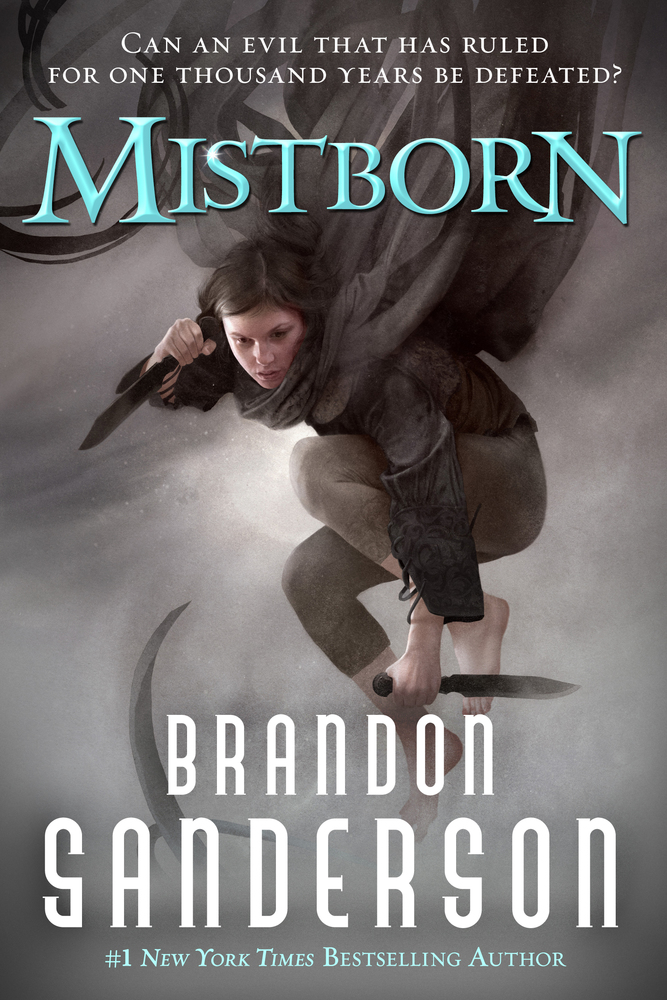
Mistborn: Final Empire


Hitting the TOR Top 10 of the Decade again, I turn to Brandon Sanderson. This is my fifth book from the TOR list, my second book from Sanderson (the first being Alcatraz Versus the Evil Librarians), and my first adult book by Sanderson ... possibly working myself up to finishing the Wheel of Time series sometime in the next few years.

I finally got around to picking this up last year after reading some Game of Thrones and that gosh-awful One Second After, and Sanderson's writing style is like good ice cream. It's fun and easy reading, cutting to the chase, and providing some very good plot. Being the second book he published, it has a couple of quirks in the prose, but overall, very impressive, difficult to predict what comes next, very captivating, and somewhat relaxing.

Kelsier is Mistborn, meaning that he can do magic of all kinds through burning metals in his belly. Yep ... you read that right. It took me a little getting used to the idea. Depending on what type of metal he swallows, Kelsier can perform feats of strength, sight, emotion, and even controlling time. By manipulating metals below him, he can even fly.

He comes across Vin, a teenager thief who exhibits potential, and something else ... he can't quite put his finger on it, but he decides to take her on as a protege and teach her Allomancy -- doing magic with metals.

Kelsier then puts together a team of lively characters to try to take down the evil Lord Ruler, who has been ruling the kingdom for a millennium, keeping himself alive with whatever magic he's using. This leader favors the aristocracy, and treats the lower class, the skaa, terribly, killing them at his whim.

But it's not easy. Many have tried to dethrone him, and many have died. Can Kelsier do any better?

I love the convoluted plot, the amazing means they use to push through slowly, getting closer to the Lord Ruler a little bit at a time. The twists and turns are fun. The description of everything is clear.

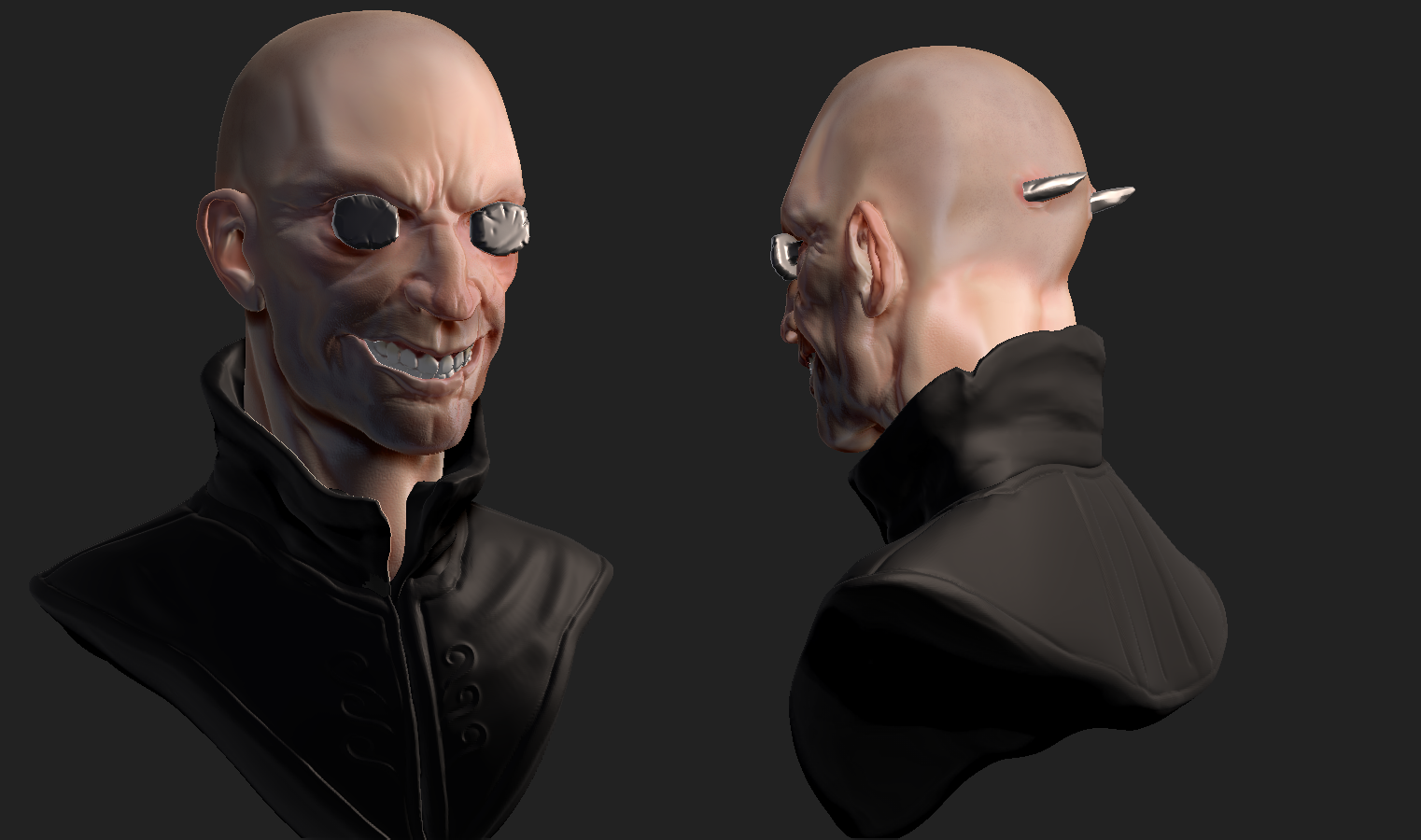
Well ... there was one point I was confused. The Steel Inquisitors imbue themselves with immense power by impaling themselves with spikes through the eyes. The way Brandon worded it the first time, I pictured the pointy parts of the spikes coming out of their eye sockets. But then almost done with the book, a friend of mine showed me a picture, and I was all ... what?! But turns out the picture was right. The pointy parts come out at the back of the head, and the flat parts make the eyes.

Yeah ... I'll blame Brandon for my confusion.

But such a little thing to complain about!

I strongly recommend reading this book. It deserves to be on the TOR top 10 list, and it sets up the next two books in the series, which I'll write about shortly.


Wednesday, September 9, 2020

The Marvelous Land of Oz


Here we are with Book #2 of the original Oz series. An interesting trivia tidbit: L. Frank Baum only intended to write the first book, but then he got deluged by requests to bring back more stories of the Tin Man and the Scarecrow. And he finally relented four years later with this sequel: The Marvelous Land of Oz.

The Scarecrow is still running the Emerald City, while the Tin Man and Lion are busy in their own new kingdoms. Then enters Tip and his gang, which you've probably seen in "sequel" cartoons, such as Jack Pumpkinhead in the Filmation "Journey Back to Oz." Tip is running away from the evil witch Mombi, and ends up in the Emerald City, where this army of angry women stage a rebellion and take over the city.

Yeah ... lots of running away in this book. Tip and the Scarecrow go to the Tin Man to enlist his help. Along the way, Tip creates some interesting creatures with his life potion. And ... yeah ... this is one of the funniest, craziest, and imaginative sequel stories I've ever come across.

I'm not sure if it made any sense, but it was certainly funny. Keep in mind that Baum was against morals and lessons in his stories ... he was just trying to have fun, and if any of that were to pop in there on its own, then so be it.

This book also introduces the future queen Ozma, who is apparently is found in one of the most unlikely of places.

Also, a little warning -- this book was written during a time where people didn't really care what went in to it. This day and age, some scenes may seem kind of strange and/or upsetting to today's sensibilities. It would certainly be attacked if it came out today. So, in that case, I highly recommend reading it for what ails you, and if you love it, you'll be a better person for it.

Have fun with it. It's another one of those freebies on the Gutenberg Project ... you can get it with or without illustrations, and some of those illustrations are hilarious. I'll most likely read more in the series ... eventually. There's .... what!!?? ... fourteen of them? One book at a time.


Saturday, September 5, 2020

Bill and Ted's Excellent Comeback


This past week I caught Bill & Ted Face the Music. And it's the first theatrical release I've seen since the pandemic came and ruined all our lives. Since our theaters are still closed, I had to stream this at home. I do wish I had seen it in a theater, but it was still an awesome ride.

Bill & Ted are much older now, and they still haven't written The Song that would unite the world and save the universe. Everything's falling apart, and they only have two hours left to write it and save everything.

It had me laughing almost the whole way through. Some parts were so funny I couldn't stop laughing. And I'm so glad I didn't watch any of the trailers, which I think give way too much away. (Above, I provide an announcement rather than one of the spoiler trailers.)

Watching the first two movies is likely a requirement for fully understanding what's going on in this third installment -- it's not really a standalone movie. My wife seemed to enjoy parts of it and laughed some, but her lack of knowledge of past events did seem to get in the way.

Most of the original magic still exists, but now these guys are older. Keanu, now famous for much more serious roles, really put his heart into it, but I have to admit that he did it a lot better when he was younger. The writing seems to be consistent with the earlier movies, and the nonsense science and time travel is hilarious!

My only complaints: one scene seemed to drag on a little too long, and the movie seemed to end abruptly. Maybe I just didn't want it to end, or maybe I was hoping for a bigger ending. But if you wait till the very end of the credits, there's a good closure scene worth watching -- pretty funny and excellent.

Also, the musician in me was very disappointed in The Song, which was the most basic typical rock-chords type of song with some dinky fill-ins by Mozart, Armstrong, and other musicians. But the movie watcher in me said, "Shut up. No song that they could come up with would satisfy you."

I really loved the song they sing at the very beginning of the movie, trying to unite the world with a song incorporating many different cultural musical influences, which was both terrible and hilarious at the same time.

If you've seen the first two movies, this is like excellent required watching for you ... so get to it. If you haven't, it may be worth renting the first two movies, and then coming back to pick this one up as well. Just be ready for some mind-bending paradoxical excellent and bogus shenanigans.

Wednesday, August 26, 2020

The Wonderful Wizard of Oz -- the Book


By far, my favorite movie has been The Wizard of Oz from 1939. It would come on once a year on CBS -- I think around spring, and I never missed a showing until I grew older. My parents got me a set of LP records that played the whole movie soundtrack, and also a book with movie stills and the entire script.

It got to where I had whole scenes memorized.

I also noticed when they showed scenes not usually shown. Here my memory is fuzzy, but I think sometimes they skipped the horses of different colors. Sometimes they skipped one of the monkey raids, and supposedly there's an extended Munchkin scene I saw only once.

I've also watched other derivative movies, animations, parodies, and retellings. The animations are only a faint memory. I loved Deschanel in the Tin Man. I hated the retelling on -- was it NBC -- a couple of years ago?

With all this in mind, would you believe it took me 50 years to get around to reading the book that started it all? Since it's so old, you can download a free copy from the Gutenberg Project, so I put a copy on my Kindle, and enjoyed every minute of reading it.

It was a different kind of style at the turn of the century. Baum claimed that he wanted to create something different from the usual Grimm stories where every story had a moral. Rather, he wanted to create a story that was pure fun, not scary, and no lessons.

Well ... he almost succeeded.

I suppose 1900 was much different than today -- at least in the types of books children read. Baum is definitely a good story teller, but his style is different -- usually getting right to the point.

And for a non-scary book, it definitely had some items that most likely would not be published today for our sheltered kids. One of the funniest and most gruesome parts was the story of the Tin Man and his curse ... how he chopped off one arm, and then another, ... and ... you get the picture.

Much of the dialogue is exactly what you hear in the movies, so many of the great one-liners appear to have come from Baum himself.

Most of the book is a journey, with a lot of world building. Dorothy gets sucked up by a cyclone (actually kind of scary in the book), lands in Oz, starts to walk toward the Emerald City, picks up some friends, overcomes different obstacles, and so on.

I was surprised to learn that one major character in the movie had only ONE CHAPTER in the book. And I do have to say that the writers of the movie certainly made one of the best decisions ever made -- to elevate this character and provide an image that can never be forgotten.

I was also surprised to learn that this book was banned in the past. What could it have possibly been? The witches? The gruesome and scary scenes (in a not-scary book)? No ... but rather it turned out to be because it featured females as strong characters not afraid to take charge and grow on their own.

So, yeah, my favorite movie/story is one of the earliest feminist stories written! (But wait till I get to book #2!)

If you haven't already done so, I recommend reading this blast from the past. Compare it with the movie -- have fun and enjoy.

Saturday, August 22, 2020

The Hunger by Michael D. Young


Michael D. Young's "The Hunger" is a fantasy novel following Azil and his friends as they set out to change the world and help to bring on the coming of a new age.

In this world, everyone can do magic to a degree. Not only do they need to eat food for physical needs, but they also need to eat Sustenance for their magical needs. Those who cannot obtain Sustenance starve and become malformed, also losing the ability entirely to do magic, thus explaining the main title.

Different colors of Sustenance provide different types of magical boosts. Red provides sight-related magic, yellow is speed, and blue is strength. These can also be mixed to provide combination magic -- orange provides sight and speed, and so on. And then there are other Sustenances that provide special boost or effects.

There are also three Keeps, each specializing in one of the three magic types, and run by three families.

Watching over everyone is Rahim, the creator, or some kind of god character. In this day, the people have pretty much forsaken Rahim in their hearts, and have become full of pride where many are poor and unable to get Sustenance. This is why Azil and friends must change things up and do what must be done to clean house and bring on the good times.

I came across this book because my friend, Michael D. Young, reached out to me (among others) to critique the upcoming next two books in this series, not yet published. As part of this arrangement, I received this first book for free. Providing a review was not a requirement, but as is customary, he did ask me to provide one if I felt inspired to do so.

I was pleasantly surprised, as friends' books usually aren't as good as more professionally-established authors' books, but this one holds really well. I love all the imagery and the world building. The magic is believable, as are the creatures and the events as they unfold. I also love the use of color throughout the whole book.

I would rate this 8.0 out of 10.0. While the story is exciting all the way through, there are a couple of unanswered questions in the area of world building. The story concentrates entirely on the big players, so we don't get much in seeing how the little people live. I'm also struggling to see how everyone can do magic, but some are better than others. It just feels like something's missing in the setup. Also, I must admit that I like the upcoming sequels more -- even in their unedited state.

Regardless of these perceived weaknesses, the story gripped me. The twists and turns are fun. The characters are endearing and distinct. It becomes hard to predict what's going to happen next. The ending is satisfying and made me want to read more.

If you're looking for something new and different, give this book a try, and look for the sequels coming shortly.

Monday, August 10, 2020

Review-a-thon


It's time for me to get things in order. Time for some housekeeping.

Some of you may wonder where my promised Coronavirus Newsletters are, but never fear ... I've decided to move them to my Economy/Political blog. That seemed like a better home for the newsletters, so I can leave this blog exploring more of my fiction writing.

I realize you probably got excited ... "I finally get to hear from Mel after being so inactive for such a long time." So, don't worry about that. I promise an upcoming Review-a-thon over the next 2-3 months. Each week, I'll review a book, movie, or other, until I finally catch up with my back log.

This will all start next week, as I got a lot of housekeeping items to get out of the way first.

Ever onward and upward!

Saturday, July 25, 2020

Coronavirus Newsletter 2020-07-25

Source: CDC
In today's newsletter: Introductions / Personal Update / Excess Death Tool / Conspiracy Entrenchers / Trump Update / Hotspots

Introductions
As of today, I'm moving my weekly coronavirus updates to here -- my writing blog, because I got tired of the Facebook interface and its boring lack of pictures, etc. But don't worry, Facebook followers ... I will still post a link on my wall to keep you informed.

For those of you following this blog -- you can see prior coronavirus newsletters with this Facebook search string I've put together.

Why do I do this? Because I'm concerned. I don't think the general public is sufficiently informed on all matters coronavirus, and I believe that if we all fully understood what was going on, we'd all know how to work together to fight this virus and end it for good.

I'm an actuary (associate), a modeler, a mathematician, a programmer, a logistician, a process improver, and a staunch follower of science. Part of my learning included how to handle medical related data, so even though I'm not an epidemiologist, I feel that I can offer a unique perspective on this outbreak, and explain things in a way that you may understand.

Personal Update
In earlier newsletters, I've mentioned that over the past month and a half I've been experiencing COVID-19 related symptoms off and on -- except no fever, and no loss of taste (though there is sometimes a funny taste). I got tested back in June and received a NEGATIVE result. And I got tested again last week at my doctor's request. After five days, I got back another NEGATIVE result. Both of these tests appear to be the same "emergency" or "quick" test and not the official FDA-approved test, though I'm not sure what the difference is.

I'm still frustrated because I don't know my current situation. I highly suspect I caught the virus in late May or early June, waited too long to get tested and had already fought the virus, and now may be fighting the remains ... randomly stored RNA fragments able to re-trigger symptoms.

Or it could a simple bronchitis infection. Either way, I'm having difficulty getting in to see a doctor, and I'm giving up because it's just not that bad. It's not worth the headache, and I'll revisit if I ever get a fever. Though, I do plan on getting an antibody test shortly.

I'm not happy about having to wait five days for the results this last time, and I hear some people are waiting for weeks for results. This tells me that we've reached our capacity of testing again, and as "actual" cases continue to rise, we won't see them in the official counts, because we can't keep up. And how can we effectively fight what we can't measure?

Excess Death Tool
I'm often asked: why do people care so much about COVID-19 deaths? Why don't people get upset with influenza deaths? Aren't these people dying from secondary conditions and not really from COVID-19? How can we trust the official numbers when hospitals are mis-categorizing unrelated deaths as COVID-19? Or how can we trust hospital counts when they have incentives to pad COVID-19 hospitalization/death counts?

For me, excess death statistics provide the answer to all these questions. Excess deaths = "Total actual deaths from all causes" minus "Total expected average deaths from all causes." What's nice about this metric is that it is very difficult to manipulate. It doesn't matter if a death is categorized as COVID-19 or as a heart-attack, because all deaths are the same. Then you can look at the big picture and ask "did a significant event occur at this time?"

In the graph at the top of this post, I've grabbed a screen shot from the CDC's US excess death tool for the City of New York. The blue bars show weekly total number of deaths from all causes for NYC for 2017 through today. The orange curve is an expected death threshold -- if the blue bars cross the orange line, deaths are noticeably higher than usual and an event is said to have occurred. These are marked with red plus signs above each breach of the threshold.

Note one breach happens the first month of 2018. This was a noticeably bad flu season for NYC -- and possibly some extra deaths due to a blizzard. It looks like a small bump, but it was enough to stress the hospital system.

And then look at 2020. Starting at the end of March, there is a very large breach -- a ridiculously high number of deaths not seen in NYC in decades. Not even the WTC attacks in 2001 had this many excess deaths. And the Swine Flu of 2009 showed practically no excess at all in NYC. (You can see 2001 and 2009 in the graph from this NY Times article.)

So, what can we say about the current COVID-19 pandemic? Is it "real"? Should we be concerned with so many deaths happening at the same time? Would it be good to continue trying to avoid further deaths?

I'll try to embed the tool here, but I'm not sure how successful it'll be on your device. Should it fail, just click on the picture at the very top of this post and it'll take you to the CDC Excess Death page. With this tool, you can select any state and a couple of selected cities, and see what kind of excess deaths have been happening. My home state of Georgia has a pretty sizable excess. My current state of North Carolina -- not so much. Utah -- hardly much at all except for the last couple of weeks. Arizona and Texas -- they were doing well except for the last month or two.


Conspiracy Entrenchers
Yet still, the conspiracies continue even today. I wrote about this a couple of days ago. Usually, I think these conspiracies are cute and easy to ignore, but unfortunately, this time it's leading many people to behave contrary to what needs to happen to eradicate the virus. This time believing the conspiracies is dangerous not only to the believers, but also everyone else ... not just the deaths, but also the destruction of jobs and the weakening of our economy.

More and more, I've witnessed many people, including friends, entrenching themselves in these dangerous beliefs. And over this past week or so, I've noticed an uptick of sincere pleas from these entrenchers, expressing a desire to be able to express their increasingly unpopular beliefs, to exercise their First Amendment rights, and to be respected instead of ridiculed. "Who is to say your science is better than my science?"

After a quick experiment, I was able to determine that these entrenchers' plea for respect seems to go only one way. They want respect for their ideas while maintaining the right to ridicule other people and their seemingly errant thoughts ... absolutely no attempt at all to try and understand opposing points of view.

And they all seem to agree on one thing: "I am never ever going to wear a mask." And so much anger. I'm sure you've seen videos of people attacking mask displays in the store and even other people wearing masks.

And I wonder ... how do people get like this? How can so many people turn against simple science and math, and simple strategies that have already helped several countries to nearly eradicate this virus?

I know a lot of it is Trump's fault and his lack of clear leadership ... sending mixed messages to the public, confusing even the knowledgable, and helping to create a perfect environment for conspiracy theories to thrive.

I also know that foreign actors are using our social media to feed us AI-generated posts scientifically engineered to maximize the division of our nation over this past decade. This is not just my own conspiracy theory, but rather a very well-documented development (of which I'll dedicate a post at a later time).

Also, ultra-conservative and ultra-liberal news sources have both contributed to this entrenchment, and I'm growing increasingly tired of watching all this intentional division.

We, the people, lose. I know a lot of these entrenchers personally, and they're all good people. I don't want to lose friends over this. As always, my goal is to get people to work together to fight this virus.

I've learned the hard way that shaming and pointing out logical errors is not the best way to convince these people to see the light ... rather, it seems to push them further into entrenchment.

When I'm diplomatic, my "contrary" friends and family react positively. They come to learn things from me, and I come to learn things from them (I've even included some of their ideas in these newsletters), and we all come out on the other end feeling more informed on the virus. I've watched several of these friends come to the point of: "Okay -- I'll put on a stupid mask, but I'm not going to like it."

But recently, I feel increasingly that we're running out of time and it's becoming more difficult to be diplomatic ... it feels so slow a process. Still, non-diplomatic solutions don't work -- so we must do our best not to shame others, and we should keep up the mutual respect, while not fearing to remind them to respect our ideas in return.

Trump Update
Which brings me to a very important message to my liberal friends. I know that Trump has been very disappointing in his leadership as per COVID-19. But back in April, he was really trying. After a couple of months of downplaying the epidemic, he helped to encourage lockdowns, and to help us through a most difficult time. But the liberal-leaning actors continued to ridicule Trump.

Right about the time Trump was ridiculed for suggesting using irradiation and injecting detergents to fight the virus, he stopped his daily briefings. He stopped talking to Fauci, and he went right back to downplaying the virus, and pushing for everything to open back up, which in hindsight was a disaster.

However, as of a couple of days ago, Trump has started his briefings again, and has told us we need to do the patriotic thing and put on our masks. Difficult times are coming again.

And please, please, please, please ... I beg of you ... we need to reinforce Trump when he's doing the right thing. We don't want Trump to revert to downplay mode, and if that happens, I'll guarantee you that his base will continue to refuse to wear masks, and deaths will continue to rise.

It's okay to pat Trump on the back and reinforce his good decisions ... then he'll see that he's finally doing a good job, and he'll continue ... and then perhaps his base will be convinced in time so that we can all finally get on the same page and fight this virus together.

If the Democrats can take the higher road, set aside politics, and work with Trump on this, I think we could have a chance at succeeding. If we instead wait four months for a hopeful changing of the guard, it could likely be too late to stop what's coming next.

Hotspots
And finally, to end ... I'd like to report that the New York Times has finally updated their hotspot map coloring scheme to now show the highest rates of new cases per capita, so now it's much easier to see where the bad spots are. And they appear to still be mainly in the South. Louisiana looks pretty bad now, and practically the whole coast of the Gulf. South Carolina is still pretty bad, and North Carolina has medium growth. California, Arizona, Idaho, Washington still look to have some strong hotspots going.

You can click the picture below to see the whole New York Times dashboard.


Thanks for reading ... and stay safe!

Thursday, July 23, 2020

Flat Earthers and the Coronavirus


It's hard to believe that some people still believe in a flat Earth. There's even a Flat Earth Society where you can keep abreast of the newest developments.

It may sound crazy, but Flat Earthers provide several compelling arguments. According to Einstein, gravity is indistinguishable from acceleration. Imagine two different scenarios:

#1) Earth is a sphere large enough to have its own gravity. Someone standing on Earth's surface will feel a constant downward acceleration (what we call gravity). If you drop a ball, it will start falling slowly, but then quickly build up downward speed until it hits the ground.

#2) Earth is a flat surface, constantly accelerating upwards. If you're standing on this surface and drop a ball, it will first appear to hover over the ground, but then the upward accelerating ground beneath it will speed up and catch up to it.

In both situations, when you perform an experiment (dropping the ball), it looks exactly the same. So, how can you tell the difference? According to Einstein, you can't tell which is which just from the experiment itself.

So ... crap? Could Earth really be flat?

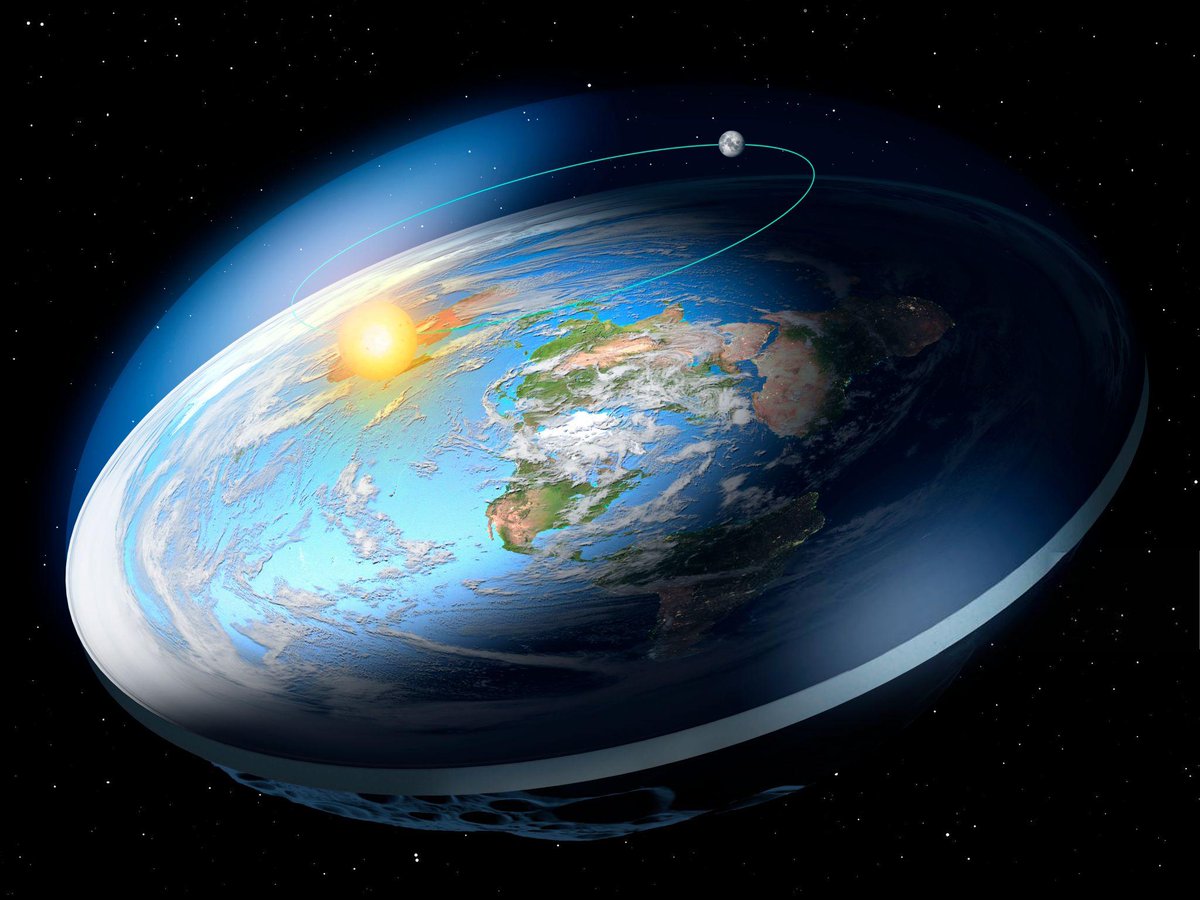
If you visit the FES site, you can get educated on how everything works ... they have an explanation for everything. From the picture above, you can see the flat Earth, with the North Pole in the center, and then the impenetrable ice shelves of the Antarctic at the border, helping to keep all the oceans' water from falling into the abyss below us.

Also note the sun floating above our world. This picture doesn't show it well, but the sun is like a lamp with a shade to help it shine down on different parts of the world depending on the time of day. The moon also orbits above our world ... in the current picture, its location would provide a full moon phase at night. As it moves to a different position in relation to the sun, you get all the other different phases.

They even have explanations as to why the sun sets ... it's an illusion due to the refraction of light as the lampshade starts turning away. Solar and lunar eclipses? There are complex explanations for those as well.

So how can we tell if Earth is really a sphere? Why should we believe the images that NASA provides to us? How do we know that they're not keeping us in the dark, and keeping us from the truth?

Hopefully I haven't convinced you that Flat Earth Theory (FET) is true, but I think it very important to demonstrate how much work people are putting into this, and how easy it is to justify it with the visage of science and math. In fact, I've tried myself to construct a flat-earth model that works consistently with our observations, just to see if it could be done. I still haven't quite managed it, though -- something always comes up to break it.

For example, if you look at the picture above, the "Southern Hemisphere" is stretched out much further than the inside "Northern Hemisphere." This would imply that planes flying in the Southern Hemisphere would take much longer to get to their destinations than planes in the Northern Hemisphere. This one issue by itself destroys FET and convinces me that our Earth is round.

But, one who is not so rehearsed on math, science, and correct principles, may easily be swayed by these intelligent-sounding arguments.

A famous rapper, BoB, tells us he's been in a plane high in the sky and didn't see any curvature, and he has recently tried to raise money to launch a satellite into space to prove it. Also, daredevil Mike Hughes started building rockets for the purpose of eventually launching himself into space high enough to see for himself if the world was flat. He ended up dying earlier this year in a failed rocket launch.

Enter the idea of "settled science," a term you've probably heard several times in the past few weeks. From a strict interpretation of the scientific method, it's nearly impossible to have "settled science," as science promotes the idea of skepticism. You start with what most people believe (a null hypothesis), you present a challenge -- an alternative theory (the alternative hypothesis), and then you perform tests to see which hypothesis wins.

Probably the most famous example of this is Newton's laws of motion and gravity, which made sense until Einstein came around to present his own laws, which did a much better job of explaining everything ... and it was revolutionary. Einstein's alternative theory won out. Newton's strongly held "settled science" theory was overthrown! (Sort of.)

Since we can't have 100% certainty on anything, we must settle for "settled science" to mean "we're 99.9% sure this is right." There's nothing wrong with challenging even the most stalwart theories, but in order to get things done, scientists and engineers need to accept what's close enough to reality for practical purposes. Thus, experts tend to hold to the stalwart theories and follow them until something better comes around.

Back to Flat Earth ... so what do you think? Is the Earth a sphere? Is it settled science? The number of people who believe FET is very small. Though, there are still some otherwise competent mathematicians and scientists trying to challenge the notion of Round Earth. We find it easy to laugh at these guys because it's just a very, very small following. We can all pat ourselves on the back because we know better.

Then, there's something called "Occam's Razor." It's the idea that if you have two competing theories to explain the same phenomenon, chances are, the most simplest explanation is the true one. When it comes to FET, I might be able to successfully create an isomorphism from Round Earth to Flat Earth Theory -- it would require a very complex set of equations and rules, such that it would be much easier to accept Round Earth Theory, as its equations are simpler, and it just "makes sense." This is the power of Occam's Razor.

In fact, everyone who does anything related to world travel uses Round Earth Theory. Planes tend to travel in Great Circles around the world, because that's proven to be the shortest distance (rather than a straight line). Satellites are placed in orbit around our planet using Round Earth Theory equations. Otherwise, our satellite TV wouldn't work, and neither would all of our GPS devices.

So, the Flat Earthers can believe what they want, but the people doing the navigating are all using Round Earth Theory -- without even giving it a second thought. Why should they care about competing FET ideas when Round Earth Theory works perfectly fine?

And finally, from the start of this post, you already know where I'm headed with all of this -- the recent pandemic.

When it comes down to it, pandemics are really simple math. The SIR Model explains the movement of a disease through a Susceptible population. As each person gets Infected, they will eventually Recover (or die), and eventually one of two scenarios play out: #1) the disease dies out, infecting only a portion of the population -- with some people reaching the Recover/Death stage, and the rest remaining indefinitely in the Susceptible stage. OR #2) the disease infects everyone until everyone reaches the Recover/Death stage.

This model along with other competing models rely on a set of underlying simple differential equations, and we have a long history of outbreaks to study, and fine tune our models.

The current coronavirus outbreak (SARS-CoV-2) is not unlike many of these other past outbreaks. In fact, some mathematicians have expressed wonder at how closely the spread of the disease matches popular epidemiology models. (Though, there are some local off-ages as this particular strain exhibits a "superspreader" nature -- where it seems to spread in chunks rather than in smooth patterns like the flu.)

From earlier, similar outbreaks, epidemiologists have determined what tactics and strategies work in combating viruses. In the case of respiratory diseases ... universal mask wearing works very well. We have not only seen this in earlier outbreaks, but we've even seen it already in the current SARS-CoV-2 outbreak. Countries that are used to outbreaks put on their masks with hardly a second thought, and have already effectively eradicated the virus -- except for onesies/twosies coming mainly from foreigners. And countries who later adopt mask wearing enjoy a sudden drop in cases after a couple of weeks of consistent habits.

In a sense, this is all pretty much settled science. Or at least, prior to 2020, there had already existed plenty of experience to support these ideas. And much of what I know on outbreaks I had learned prior to 2020. You can't really learn basic modeling of data without having some exposure to exponential, S-curve, and other distributions that describe outbreaks. In fact, one of my textbooks was on how to truncate data effectively, geared more toward medical applications.

I suppose a little bit of inconsistent mishandling of the pandemic by the WHO and a lack of direct experience in the US has led to our current situation where most people don't seem to know how to behave in such a way to effectively fight the virus and eradicate it (as many other countries have already successfully done). And perhaps it's the whole idea of "free thought" in the US that has given credence to competing theories.

Unlike FET, where a very small people believe the very few skeptics, we have a situation where a very large number of people believe the very few skeptics ... and most frustratingly, it has become yet another highly charged politicized topic -- which has unfortunately led to too many unnecessary deaths.

To me, the solutions are very simple ... we could have eradicated this thing months ago, and avoided a nationwide shutdown. But we were lazy and we let it get out of hand. In April, our lockdowns helped us to get a handle on things -- numbers were going down, but then we thought it was safe to reopen everything, and we didn't do so safely. So (as what exactly happened in 1918-1920), cases in the US have blown up to levels not seen anywhere else in the world.

Instead of taking simple measures to win, we're flooded by crazy conspiracy theories ... the Democrats are trying to nuke Trump's reelection chances ... Bill Gates is trying to sneak in microchips in the upcoming vaccine ... masks are activating COVID that's been around for at least a decade ... hospitals are lying about the deaths and attributing them all to COVID, and so on.

There really is no difference between FET and these pandemic conspiracy theories, and I'm not sure what I can do about it. I can only watch in disbelief, and hope for the best. How can someone really ignore what is going on outside of our borders?

Despite the fact that these conspiracy theories are enjoyed by a large chunk of people, the theories are still worthy of ridicule and scorn. Unfortunately, this is very difficult to pull off on social media, because your friends are likely to take it personally. I always try to attack the ideas and not the people, but peeps today are very fragile. My goal is to help people understand so they can behave in such a way to help fight the virus ... together. But that's not how they take it.

Most people are being manipulated by forces intent on dividing our nation and to increase the spread of the virus -- encouraging "not settled science" as their battlecry, and "1st Amendment" / "freedoms" (without realizing that wearing masks is a means to enjoy more freedoms), and "you can't stop this virus -- no one can" (even though so many countries have demonstrably done so), and so much quoting of bad science studies.

I wish you all well, and be smart! Listen to the experts because they've been doing this for years. Ignorance can only kill, and intelligence is the only way to win. My hope is that if you can see the silliness of FET and understand how some people come to believe in it, then you may also be able to see the exact same things in COVID conspiracy theories today.