Thursday, February 20, 2020

Is Purple Really Not in the Rainbow?


You ready to have some fun? If you love color and rainbows, and don't mind a little experimenting, get ready to learn stuffs.

Let's start with a quick quiz. Get out a piece of paper, or open up a notepad app, and write down the color you see in this pretty flower. Blue? Purple? Some other color?

Okay, and again, look at the swatch of color below, and answer the same question. What color do you see?


We'll come back to the answers you've written after you watch this quick Minute Physics video, which claims that purple is not in the rainbow and that Newton's "violet" was really a dark blue.

Don't worry -- it's only a couple minutes long, and it'll be fun tearing it apart afterward.


After having watched the video, what do you think? Is Henry right ... is there no purple in the rainbow? Can I, a non-physicist, even hope to prove this guy wrong? Especially when so many reputable science websites have been referring to and using this video? Check out this article from the Smithsonian.

The nice thing about science is that anyone, anywhere, can test any scientific claim, provided they have enough tools to do the job. So, over the past month, I've been testing, interviewing, researching, and compiling, and now you can see all the gory results.

First off, let's talk about where Henry Reich (the Minute Physics guy) is right. By definition, violet is indeed the color at the end of the spectrum as we see it. It is monochromatic, meaning that its color consists of just one wavelength of color.

Also by definition, purple is indeed the combination of two colors: red and blue. In other words, it's bichromatic, having two wavelengths of color mixed together. So far it's not looking good for me -- Henry is winning.

And what about this picture I took of a rainbow that clearly shows purple on the bottom? Is this a win for me?


Alas, if you zoom in to the purple region and look carefully, you'll see the supernumerary rainbows Henry describes in the bottom right-hand corner, starting in the middle of the purple band. Are the additional reds at the bottom mixing with blue to make purple?


Dang! Looks like another point for Henry. Should I just give up now?

Not so fast, Dr. Eggman!

Henry is wrong on one very important detail. Violet is not a dark blue as he describes, and I can prove it.

To clarify what I mean, let's define "blueish" as describing a color that appears to our brains to contain only blue and no red; and "purplish" describes a color that appears to consist of both blue and red.

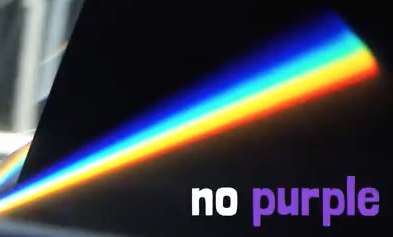
For example, check out this screen cap from Henry's video. Looking at the end of this rainbow, I see no purplish hues. There isn't even a hint of red in that violet end. Do you see any purple?

But I'm not done yet ... wait for it. When it comes to flowers, have you ever seen a blue violet? Or ever wondered why the poem says "violets are blue"? (The truth is they couldn't find a good rhyme for "purple.")

I will explain later two phenomenon as to why the picture above is missing the purplish hue at the end. Then you'll see how it's a terrible representation of the full spectrum as our brains see it.

Try this really fast ... do an image search on "real prism rainbow," and you will see about half with a blueish hue at the end, and half with a purplish hue.

Here's one pic I found that sports a purplish hue:
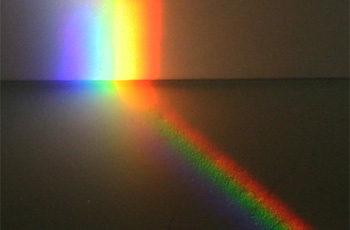

What's going on here? Why the contradicting pictures?

The best way to understand is to conduct your own experiments. The first thing I did when I heard the terrible news about poor purple was to find a prism-generated rainbow and check it out, myself.

I found one at work projected on a white table. I invited three victims to come and look at it with me, and asked, "What color do you see at the end of this spectrum?" They all answered: purple. (I took this picture with my iPhone 8.)


What color do you see at the end?

I also found a prism-generated rainbow at home. Check this out. I'll even zoom in for you in the image on the right. Also taken by my iPhone 8.

What color do you see at the end? Would you call it dark blue, or some kind of purple? 

Note that any purplish hue you may see here is not coming from any supernumerary rainbows, which only exist in rainbows produced by thousands of rain droplets. The science here is different. Most spectrums created by prisms are "pure" ... you only get one iteration of the spectrum, and no overlaps.

Remember those colors I had you write down at the very beginning? Check your answers. The first picture is a violet I've owned over the past few years. It has always looked purplish to me. And the swatch of color comes from my prism picture just above -- again, it looks purplish to my eyes, not blueish. There's definitely more blue than red, but there does appear to be some red included.

In fact most people describe spectral violet as a mixture of 1 part red and 2 parts blue -- kind of like mixing blue and purple together.

Let me hit you with four color swatches and let you compare them all. The first is magenta -- 2 parts red and 2 parts blue -- definitely not in the rainbow. The second is a generated violet -- 1 part red and 2 parts blue -- which many seem to think appears in the rainbow. The third is the violet color grab (from the very top) -- it was in my rainbow, and the fourth is the blue demonstrated by Henry at around 1:26 (which never looks purple to me in his video -- BTW).


Which one of these looks blue to you (containing no red at all)? If you answered, "Only the last one," then perhaps Henry is wrong? And so are all the other reputable science sites that cited him?

Then again, I can understand the confusion -- red and blue are on opposite sides of the rainbow and every other color seems to make sense. Yellow falls between red and green. Orange is between red and yellow. Cyan falls between blue and green, and green between yellow and blue. But how does red wrap around all the way to the other end of the spectrum to make purple/violet?

Let's dive into this.

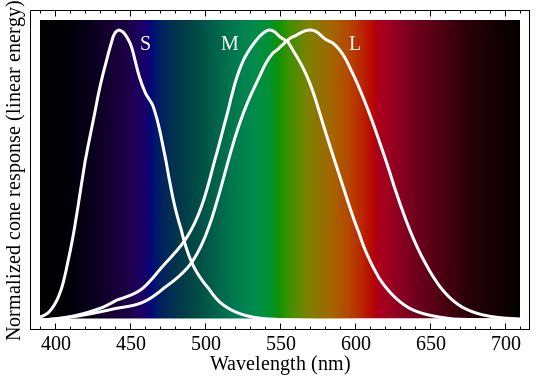
Most of us have three types of cones at the back of our eyes. One is mostly sensitive to red light, one to green, and one to blue. Wikipedia and several reputable websites show graphs similar to this to show each cone's sensitivity to light.

TV's and computer monitors take advantage of our cones. They're made of only three colors: red, green, and blue -- matching each of our three cones. And most all the colors we see can be emulated by different combinations of brightnesses. Here is one of many websites that explains this phenomenon. And here's a close-up of a typical monitor:


Consider pure yellow light, which activates both our red and green cones. A computer screen cannot shine yellow light, but it can shine red and green at the same time to emulate yellow. And our eyes can't tell the difference!

To experience this cool phenomenon, you can play around with this cute tool I found: an RGB Slider. If you go to the link, you can slide R(ed), G(reen), and B(lue) sliders to try to get any of 16 million colors.

Try these combinations:
Red = All R, No G, No B.
Yellow = All R, All G, No B.
Orange = All R, Half G, No B.
Cyan = No R, All G, All B.
Magenta = All R, No G, All B.
Purple = Half R, No G, Half B.
Violet = Half R, No G, All B.
White = All R, All G, All B.
Black = No R, No G, No B.

See what other colors you can produce. It all comes from just three colors with different levels of brightness. And it only works for human eyes. Animals looking at our screens would see something completely different and strange.

If it wasn't clear before, it should be clear now ... you can't have purplish hues without a hint of red. I challenge you ... dial Red down to zero, and then shifting only the Green and Blue sliders, can you get a purplish hue to appear?

Then, how in the world can we see purplish hues in the violet range (400-450nm)? I've come across a few theories among the Internets.

One theory is that the absence of green triggers our brains to see purplish hues. Maybe this is the case, but it doesn't satisfy me. When I hit the RGB slider with R=0, B=127, G=255, and then slowly lower green, I don't think I ever see purple as green disappears.

Another theory is that there's actually a second peak in the red cone sensitivity. This website shows the following picture (the extra gray line shows sensitivity of our rods for night vision). Note the small bump in the red sensitivity in the 380-430nm range -- which would explain how we see purplish hues. I like this theory, but unfortunately I can't find any credible sources to support this idea. And if it were true, why don't all websites show this bump?
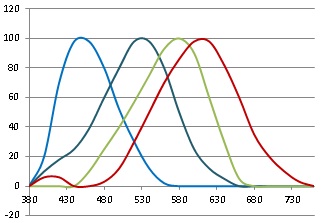

Another theory is a combination of the two above, where if you look at the sensitivities in absolute values and not normalized to 100%, it could be that the red cones drop off in sensitivity slower than green -- so that when green drops out, there's enough residual red to give us purplish hues. Kind of like this ...


Whatever the cause, most humans seem to report purplish hues in the violet range, as evident in the CIE 1931 color matching scheme. This website goes to great lengths to describe all the experimentation with lights and all the formulae that went into being able to imitate practically all colors from just three lights: red, blue, green.

The CIE 1931 scheme plots most colors like so:
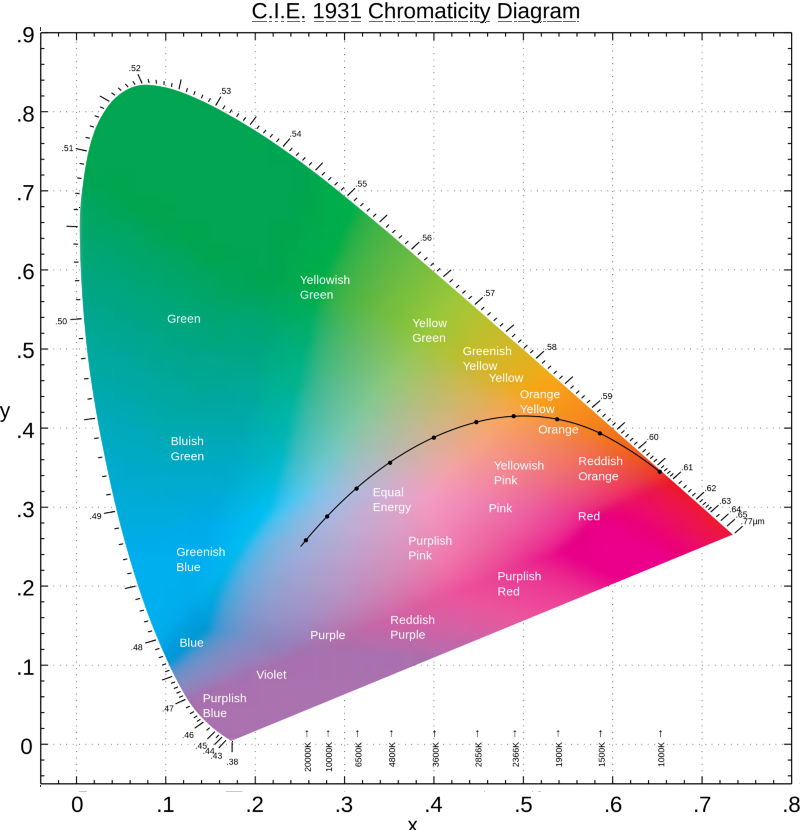
The pure spectrum exists along the upper outer edge, starting from the 770nm mark in the bottom right-hand red corner going along the green top around the 520nm mark, and then down the left side to the 380nm mark in the lower left-hand corner described as "Purplish Blue." The diagonal line along the bottom is not part of the spectrum. According to this scheme, "purple" is not in the rainbow, but "blueish purple" is. In other words, violet is a purplish hue, and not dark blue.

And check out from that CIE 1931 website, the standard RGB sensitivities used to emulate the spectrum ...


See that red bump in the 400-500nm range? I've scoured the webs, and I see that different versions of this chart are universally accepted anywhere it talks about CIE 1391 color matching. And all charts show two red bumps -- one big and one small.

Here's a nifty tool. It's a spectrum emulator, where you can shift the slider and see the resulting RGB makeup. Note how it shows purplish hues in the violet range (380-430). You can even see the "R" number rising in that range. Play around with the tool and have some fun with it.

If you made it this far, either you really like learning stuffs, or you still need more convincing. Why is it that Henry's picture of the spectrum up top shows deep blue and no purple at all? I believe this is due to two phenomenon.

#1) Our eyes have a hard time seeing violet. Once you get below 450nm, it becomes harder for our eyes to see it. In fact, in my many experimentations, there were plenty of times when I saw only the blue and no purplish hues. But if the light source is bright enough, violet becomes easier to see. It also appears to me not only to be purplish, but also "glowy" or "radioactive." That is, it seems to shimmer more than the other colors. In your experimentations, if you don't see "purple," you might want to try a stronger light source.

And #2) It turns out that some cameras have a hard time resolving violet as "purplish", but rather renders them as a dark blue color. Evidently the Panasonic FZ200 has this issue. If you're interested to learn more, here's a very informative video explaining these shortcomings in some cameras.


If such deficient cameras were to take pictures of spectra, they would only see blue at the end. I would further venture to postulate that if a human doesn't have a secondary peak in their red cones, they may likewise see just dark blue in the violet range. I found nothing supporting this, but could explain why some people claim not to see purplish hues in the violet range. To them, violet would look blue to them in real life and purple on a computer screen. Evidently, my iPhone 8 has no problem resolving violet as a purplish hue.

If you're still not convinced, you can check out these videos featuring "purple" lasers that shine a monochromatic 405nm -- well into the violet range. In each video, the lasers appear to be purple. You only need to watch a few seconds of each to get the idea. Keep in mind that lasers only emit one wavelength of light -- and not a mixture of red and blue.


And finally, let's come full circle by returning to rainbows. If I'm right, then shouldn't we be able to see the pure "purplish" violet in a rainbow? Turns out we can ... if the light source is bright enough and conditions are right. In fact, here's a screen shot from Henry's video, where it demonstrates a simulation of supernumerary rainbows based on raindrop sizes. At the very beginning of the clip, there are no supernumerary rainbows, and then as the drops get smaller, they appear and become more numerous.

I've found the actual website here if you want to play around with drop size. From that same website, this page shows the pure colors that combine to create the supernumerary images, and note that it depicts violet (400nm) as a purplish hue -- not dark blue.

And take a closer look at what color is depicted in this near-none-supernumerary rainbow simulation.


Doesn't that look purplish to you?

Now it's your turn. Do your own experiments. Find prism-generated rainbows (can't rely on rain-generated rainbows because of the supernumeraries) -- if you're observant enough, they're not too hard to find. And report back ... what color do you see at the end of your rainbows?

Update: 5-11-2022 


As if we need further evidence, we now have "purple" lights that are peppering our nighttime cityscape. These were originally white LED street lights, but because of some defect, they have turned partially purple. You may see these if you live in North Carolina, Iowa, Florida, Arkansas, Texas, or Kentucky.

At first, I thought that the lights were losing the green, leaving red and blue to make purple. But then I wondered why my glasses weren't separating out the red, as I see with purple Halloween lights.

I decided to do a spectral analysis with my handy-dandy diffraction grating, and sure enough -- there is a big bump in the blue section, and no bump in the red. The violet light was too dim for me to make out, but the blue bump extended as far out as I could see. Either way it was clear -- this was NOT red+blue = purple.

So -- wow! These lights are really blue and violet. As you can see, my camera is picking up both blue and violet (depending, I think, on the angle). 

Additionally, you may wonder why some of these lights look more "purple" than others. It turns out that it's not one LED light, but rather an array of many. The particular light pictured above had probably around 20 individual LEDs, a few of which were still shining white. So, one can watch a particular street light slowly transition from white to full "purple" as the LEDs go bad, one by one.

Enjoy these violet lights as long as you can, as they're slowly being replaced, and then we'll only have red+blue = purple lights left during Halloween and Christmas.

Monday, January 20, 2020

Goals Revisited


Last year I was all gusto about setting annual goals. I posted in all of my blogs: This is what I'm going to do this year. In some cases, I killed my goals, and in other cases, they killed me. It's all fun to get all excited and make plans, but then -- as my friend helped to point out -- they can be a source of major depression. It's very possible to get a lot done and then look back at what you wrote 12 years ago at a massive list of things you didn't get done. The result: depression and a sense of non-accomplishment.

I'm reminded that the Stephen Covey books on 7 Habits talks about ongoing (long term) goals and weekly/daily (short term) goals, but not "yearly" goals. In fact I now remember Covey talking about how the year is too long an interval for effective planning, and too short an interval to accomplish the tasks. I remember saying, "I'll keep my annual planning, thank you," but now I wish I had listened. I don't think I've ever accomplished ALL of my annual goals, and I've let it convince me that I'm a loser.

I'm sure many of you have seen this often at work. Bob works hard and got a lot accomplished last year, but when the time for annual reviews comes around there are two tasks written down that Bob just didn't get to. Even though Bob was an excellent employee, he gets a smaller raise than he deserves. If you ask me, it's all an excuse for businesses to not hand out more money than they have to.

So, no more annual goals for me -- and I will also be doing away with the bimonthly updates. I have long term goals, and they're not really changing year-to-year.

However, I do think a look back on the prior year is healthy. As for blogging, 2019 was the lightest year yet for me -- and this is true in all my blogs. Most of my free time went to composing during the first half of the year and into my publishing company, Melkim Publishing, during the last half.

I finished composing and submitted six hymns and four primary (children) songs to my Church for consideration in their upcoming new hymnal. As part of this, I made a few friends, including Michael Young, a singer and prolific lyricist who collaborated with me, and future items may be in the works.

I also continued my friendship with Daniel Carter, the composer of one of my favorite Christmas songs, Shine for Me Again Star of Bethlehem. We've been working on some semi-large projects, and we have lots of good ideas floating around -- helping each other out. I also started publishing a new composer, Paul E. Anderson, nephew of the Paul Anderson who penned several hymns in our current hymnal.

I also did get in some blog writing, and as usual I have plans for some more fun posts. I did write and enter a story into the biannual Actuarial Speculative Fiction Contest, but I never heard back from them -- now under new management. I take it I didn't win. Either that or the Contest fell apart. Not sure ... don't care ... I won't waste any more time with them. I did enjoy writing the story, though: "The Immortal Actuary."

I hope you had a great year in 2019, and I hope you have a great year in 2020. Keep pushing forward.


Wednesday, November 13, 2019

A Clash of Kings -- The Mayhem Continues


A Clash of Kings, the second book of George R. R. Martin's A Song of Ice and Fire, a series also affectionately known as "Game of Thrones," picks up where the first book leaves off. Throughout some 700-800 pages, it introduces new characters, kills off many, and forwards the story.

By the end of the first book, the Stark family had been spread out among different parts of the land, and similarly, the second book primarily follows what happens to each of them. Of course, this opens the door wide for plenty of side stories along the way. Plus we learn more about the almost entirely separate story of Daenerys Targaryen, stuck in the eastern continent of Essos -- you know - that land mass that doesn't get a map in the first two books? Though separate, we learn more about how she is tied in with what's happening in Westeros, where most of everything else happens.

I had earlier complained that the first book was about 5% fantasy and 95% politics and war -- so much so that one might doubt if it could be considered "fantasy," but A Clash of Kings increases the fantasy elements to roughly 20%. Now there are dragons, magic witches, more info on the White Walkers or whatever you call those zombie creatures, and so on. Still nowhere the amount of fantasy in a Robert Jordan book, but getting there.

And as you may suspect, that other 80% that is politics and war continues to engage. It becomes so addictive!

Yet, reading the actual words is still a chore. Martin loves to take pages to describe the simplest of things, which provides a rich and immersive environment, but sometimes I just wanted the story to move on. One of my favorite examples of this was when Theon Greyjoy meets this girl at the beach, convinces her to come home with him, and tries to seduce her along the way. This goes on for about 20 pages. It was worth the payout, but man ... that author can just go on and on.

Around page 400, the run-on sentences seemed to become more frequent, slowing me down even more. It took a while, but eventually I finished reading the book to its end, bringing various endings to each individual Stark story, and making me want to read more ... once I get up enough energy to continue, that is.

I have yet to see the TV show, but I'm still enjoying reading these books. If you have a lot of time on your hands, give it a try.

Tuesday, October 29, 2019

2019 Checkpoint #5

I know, I know. There haven't been many posts by me here recently. I've been very busy--doing other things. Business is really picking up with Melkim Publishing, requiring more time, but in the long run it will be worth it. There are so many "good" things in life that I can do, and there's just not enough time to do it all.

And yes ... I still have all these stories that want to be told, and it's so easy to come up with even other newer ideas. As my teachers in school told me often -- I definitely have ideas.

As long as I'm pushing forward and making progress, I'm doing something right. So, I'm not going to beat myself up, and just let it all happen. Right now, writing fiction is just less of a priority, but I'm going to come back to it sometime soon, lest I go insane!

Saturday, September 14, 2019

One Second After: It Fried and Then Died [Spoilers]


Have you ever read a book and realized it was the worst you've read in over a decade? How about two decades? I only finished One Second After because I wanted to give an honest review. Or was it because I hoped it would finally redeem itself? Or was it the train wreck syndrome?

In a nutshell, the writing was boring, the plot was convoluted and predictable, the science was iffy, and the behavior of civilization was entirely unbelievable. After I deliver one more paragraph of a brief intro, I will be dropping spoilers throughout the rest of the review, so if you plan on reading this book, you may want to stop now and run for the hills.

John Matherson is a resident of Black Mountain, NC. While talking to his military friend on the phone, and right after said friend says, "Wait. Something big is happening," the power goes out -- everything stops working, including things not plugged in, such as most cars, phones, and other handheld devices. The entire US had become the victim of an ElectroMagnetic Pulse (EMP). John must work with others to help the residents of Black Mountain survive without electricity.

This actually sounds exciting, and I must admit that I was grabbed at first. This book was recommended by people at work, and I love a post-apocalyptic scenario. I also enjoyed the book's coverage of the Black Mountain and Asheville area -- an area I've visited a few times.

Okay ... got the "good" things out of the way. So, what didn't work?

I already mentioned the boring writing. It was flat and relied mostly on dialogue. Yeah, most of the book read like meeting notes as people stood around arguing about what to do next. Even when the book attempted to build to a big battle of baddies coming into town, it ... (I can't believe I'm writing this about a professionally produced book) ... it skipped the whole battle and went right back to people standing around talking about what had just happened. Noooooo!

The science is based loosely on fact. If one were to explode a sufficiently strong nuclear weapon above our atmosphere, the resulting radiation burst would interact with our atmosphere and magnetic field to create a large EMP current, which can damage equipment (anything in the line of sight from the explosion). This happens through something called the Compton Effect.

Though the Compton Effect is real, William Forstchen, the book's author, overestimates the damage that can be caused. You can check out the wiki on nuclear electromagnetic pulse for more detail.

Summarized here:

Small electronic devices (like phones) are likely to survive because there is probably not enough circuitry to resonate with the pulse. This would also be true of pacemakers, most cars, watches, and so on. (Though, the phones would have no service.)

Planes flying at high altitudes would probably survive, as the main effects of an EMP is at the lower altitudes.

Things that are not plugged in at the time are believed to be more likely to survive an attack.

A couple of tests were conducted in 1962. One over Hawaii, which burned out some street lights (but not all), and set off burglar alarms; and one over Russia, which probably caused more damage.

The higher the weapon is detonated, the weaker the effects are due to the inverse power law. But higher explosions can reach further (line of sight).

The stronger the weapon, the stronger the effects.

Could terrorists pull off such an attack? As per One Second After, the enemies attack with the intention of killing off all the inhabitants while preserving the land and infrastructure. But there are problems with carrying out such an attack. The bomb has to get to an ideal altitude, which is difficult and expensive. It also has to be strong enough do a lot of damage, also difficult and expensive.

In fact, it would be so expensive that many experts believe that it would be much easier for terrorists to just nuke the people outright.

Also, should someone launch such a weapon, its signature would be picked up, and we would know where it came from. The retaliation would quickly destroy the parties that launched it.

In other words, there just wouldn't be enough incentive for anyone to pull off such an attack.

Would the US civilization fall apart as rapidly as it did in One Second After? I doubt it. We humans are pretty resilient and can remain good-natured even in the most dire situations. When we're all in the same boat, we tend to come together and work things out. Look at when New York City had an extended blackout a few years ago. On the most part, the people evacuated the city in an orderly manner, shooting the breeze with perfect strangers while crossing the bridges leading out of the city.

Early on in the book, we read that a Black Mountain old folk's home is utterly abandoned. Seriously? People are going to be that selfish and not go out to check on the elderly and sick? Look at hurricanes that recently devastated parts of the southeast, and look at how many volunteers stepped up to help with the cleanup. Something that not even one person thought of in Black Mountain?

I get the part about how sick people (who need electricity to survive) would die quickly. Not much could be done about that. I get that there would be challenges, such as how to keep everything sanitary, but there exist people who know how to handle those types of situations. We'd figure things out.

Not only that, I think we'd get our power generators back up and running much faster than how it does in the book. Our lives would be wrecked big time, but we'd quickly rebuild. It's not like we smart people would lose the knowledge we had before the blast.

And get this ... near the end of the book, John learns that due to his awesome leadership and know-how, his little town of Black Mountain is the only city within thousands of miles to have any kind of survival success. John is just that smart while everyone else in the world is selfish, or idiotic, or just simply unknowledgeable. And believe it or not, this wasn't the most arrogant thing I read in the book.

In real life, Forstchen really is trying to prepare us and encourage us to EMP-proof all of our electronics. I don't think this is too difficult to do to any one piece of hardware, but overall it could be expensive across the US, and in many cases unnecessary. Forstchen has many dealings with Congress, trying to get them to pass legislature. He wrote this book as an example of what WILL happen if we ignore him. Yes, I really mean "WILL" and not "COULD." If you read his book, you'll see what I mean.

Since Forstchen is the author, you'd never guess, but everything proceeds EXACTLY as Forstchen predicts events would proceed in real life. Thus, at the very end when John's daughter dies from diabetes when they run out of insulin, we're supposed to be flowing tears and saying, "Screw us all for not listening to Forstchen. Our ignorance killed this daughter! Wait -- we're not really dead yet. We still have time. We can still fix this."

But instead, I ended up thinking: "Screw you, Forstchen, for creating such a convoluted story that ended up killing this perfectly good daughter, whom I never really got to know throughout the book, since the writing was so bad."

Here are some actual quotes from the book where Forstchen has his self-fulfilling told-you-so moments:
"The crime, the real crime, was those who truly knew the level of threat doing nothing to prepare or prevent it. Bitterly he wondered if they were suffering as the rest of the nation now suffered or were they safely hidden away, the special bunkers for Congress, the administration, where food, water, and medicine for years were waiting for them ... and their families?"
"Remember Jonestown. ... nearly a thousand of them committed suicide on account of some d*** nutcase who told them to drink Kool-Aid laced with poison because God had ordered them to. Look, you get people scared, then you knock out every prop that we've taken for granted. ... [there] will still be hundreds of thousands of barbarians on the march and the rest of us running, scared ... D*** our enemies who did this to us, they knew us well... They knew human nature too well, and just how fragile civilization is, and how tough it is to defend it. Something we forgot."
The sad part is that if you go read reviews on this book, you're going to see a whole slew of 5-star reviews. What this book does well is to give a semblance of teaching something "no one else knows," but needs to know. Readers talk about how this book completely changed the way they look at life, and I'm like ... really? Is it really that simple to believe what one man writes and not do any quick independent research on the web? And not to mention ... is no one else phased by the terrible prose and contrived plot and the terrible way that civilization reacts to the attack? And if I write my own book where people just stand around talking to each other, it'd sell well?

Perhaps I should just give up now. Go read this best-selling book.

Friday, August 30, 2019

2019 Checkpoint #4

It's time for the bimonthly check in. I wish there was good news to report, but the last two months have been abysmal when it comes to me writing the written word. As reported in one of my newsletters, I've had my family together for the first time in years, so I took at least a whole month off just relaxing and enjoying family.

Now they've gone back to school, it's time to get back to the grindstone. My work friend was ribbing me a couple of days ago, saying, "My new boss has published a sci-fi novel. It'll be nice to work with an actual published author." Yeah, yeah ... I need to finish polishing my own novels and get them out there. Maybe I'll punish my friend and have him be a critiquer/reviewer. Bwe-ha-ha-ha!

However, to help me get back into a good rhythm, I'm going to start with my long list of blog entries to write -- catch that up and then get back to short story/novel writing in a couple of months. So much stuff in my head that wants to come out on paper!

Wednesday, August 28, 2019

Detective Pikachu: Easter-Egg-Filled Fun


When you don't go in expecting much, some movies can pleasantly surprise. Pokémon Detective Pikachu did this and more, providing good laughs, fun action, a few feels, and tons of easter eggs. My kids and I all had a lot of fun watching. (Yeah ... I'm doing a little catch up here -- believe it or not, this is still the last movie I've seen in the theater -- something I need to rectify shortly.)

Tim Goodman is a young good man (get it?), who is at first reluctant to take on a Poké-buddy to train. But one day while investigating his father's disappearance, he runs into a talking Pikachu -- though he's the only one who can understand him. Weird--Right? Who knew that Pokémon could all speak with each other?

I thought I could guess what came next, but a series of twists and adventures proved me wrong ... mostly.

Though fun to watch, the plot is very light. It was just enough to keep us awake and entertained. The CGI was pretty good and true to the original material (unlike some other movie trailers that shall not be named).

And of course, this is one of those movies where if you think too much, it starts to not make sense. There's one scene in particular in which something large happens and then goes back to normal as if nothing ever happened. That was when all of us looked at each other as if to say, "What just happened?"

I also don't understand the concept of everyone having their one and only Poké-pet. It reminded me too much of the Golden Compass stories, and not Pokémon. I mean, the original show was never: "I gotta catch that one!" Or maybe I missed something.

Other than that -- it's good clean and light fun. I'd probably watch it again if I ever caught it on TV.


Wednesday, July 10, 2019

2019 Checkpoint #3

My progress always seems to go in spurts. Since my last checkpoint, I started out strong the beginning of May, but then it all petered out when I switched to working on hymns full time preparing for the July 1st deadline.

Oh yeah ... I actually wrote hymn lyrics for the first time ever.

These two hymns are: "He Died So I May Live" and "Father, Be Near Me."

They took a while to write and modify, and modify again.

Now, ever since July 1st, I've been slowly starting up the machine again. Look for more blog posts in the near future.

Enjoy life and continue writing!

Sunday, May 12, 2019

Endgame: Straightening Out The Timelines

I just got back from watching Endgame a second time ... this time in IMAX. Now are you ready to dive into the time travel and straighten it all out? MAJOR SPOILERS if you haven't already seen the movie.

First off, make sure to read my general rules of time travel in a Many-Worlds model ... here. Or you can just accept the synopsis here: you can only travel forward in time along your own timeline (can't go to other branches); you can only travel backwards along your timeline (backward along the branches); when you go back, it automatically creates a new timeline (a new branch); and tethers are the only way you can return to an original timeline.

Okay, we will begin with a simple timeline. This is the line on which all of the first 21 movies occur, and it looks like this:


Looks exciting? We'll call this Timeline Zero.

In 2023, the first time travel trip has Hawkeye going back to visit his family farm. He doesn't stay long, and he doesn't really change anything. Technically, he does create a new timeline (branch), but it would look very close to Timeline Zero. So, we'll just ignore that trip.

Once they know time travel works, the Avengers and friends split up into three different teams that go back to three different times. We'll handle the easiest one first ... Thor and Rocket going back to Asgard.

Arriving in 2013, Rocket steals the Ether from Jane and gets chased by folks while Thor talks it up with Mom. Thor then summons Mjölnir. The fact that things happen differently is evidence that the Many-Worlds model is in effect. In other words, we have a new branch. We'll call this Timeline Thor-2013.

Thor and Rocket then return to 2023 Timeline Zero thanks to the "GPS" tether platform combination that Tony Stark created. Without the tether, Thor and Rocket would have been stuck in Timeline Thor-2013.

This is what our time map looks like now:
The red dot and arrow represent the trip back to Timeline Zero.

Now a slightly more involved trip ... another team goes to 2014 to visit Morag and Vormir. Rhodes takes the power stone and returns. Nebula is captured by Thanos. Black Widow sacrifices herself so that Hawkeye can return with the Soul Stone. Thanos at a slightly later time figures out how to use the Pym Particles to arrive in Timeline Zero to stop the Avengers. We'll call this branch Timeline Thanos-2014.

The updated map:

The green dot and line represent the return of our Avengers (minus Black Widow) to 2023, and the purple dot and line represent Thanos' trip to Timeline Zero. We have no idea how long Thanos took to prepare for the trip ... a year? a week? But we do know that his ship arrived later that day in 2023.

Now the confusing one: A team goes back to New York in 2012, and whoa Nellie! Captain America secures the mind stone after fighting with himself -- definite evidence that we're dealing with a Many-Worlds model. Professor Hulk secures the time stone after listening to the Ancient One's nonsense about time travel. He also promises to return all the stones to their original places. Ant-man and Stark try to get the Tesseract, but fail miserably. Loki escapes amid all the commotion. Uh oh! We'll call this Timeline New-York-2012.

Stark and the Cap decide to go back to Indiana to get the Tesseract and more Pym juice. They end up in 1970. Stark grabs the Tesseract, runs into his father, while the Cap gets the Pym juice and sees his old girlfriend Carter through the window. We'll call this Timeline Indiana-1970.

Then Stark and the Cap return back to Timeline Zero.

Here's the new map:

The red dot from 2012 represents the Avengers who went straight back to 2023, while the brown dots and lines represent Stark and Cap's trip to 1970 and back to 2023.

Okay ... so far so good? Right now we have five total timelines. With everyone from all timelines returned back to 2023 in Timeline Zero, the big battle ensues. Thanos dies. Stark dies. Everyone cries.

At the end of the movie, the Cap volunteers to go back and return all the stones. However, there's one small problem. If the rules say that you can only travel backwards along the current timeline you're in now, how could the Cap ever return to those other 4 branch-off timelines? This is where I've seen many articles say that the Captain time travel bit broke everything.

But not so fast!

My work friend came up with the perfect answer. The Infinity Stones, themselves, want to return back to their respective timelines. So, as the Cap enters the quantum world, the stones would tether him back to the correct timelines.

As the Cap explains, he delivers the Time Stones first. Each jump requires a Pym juice bottle, but now with Mr. Pym back, we can assume that the Cap has sufficient vials for all the trips. He can deliver the Stones in any order he wishes, but for the sake of my picture, I'm going to say he travels to these in reverse order.

He hits Timeline Thanos-2014 to return the Soul Stone (wonder how that goes?), and the Power Stone. Then he goes to Timeline Thor-2013 to return the Ether (does he have it injected back into Jane?) and most likely also returns Mjölnir. Next comes Timeline New-York-2012 to return the Mind Stone (minus staff? -- he didn't bring that back) and the Time Stone. And finally, Timeline Indiana-1970 to return the Tesseract (how does he get it back to cubie form?).

From there, he can travel backward in time, following Timeline Indiana-1970 to the end of its branch and continuing on down Timeline Zero until he hits 1940's, starting a new timeline. We'll call this Timeline Carter-1940's.

After living a full life with his girlfriend, he decides to go back and give his shield to the Falcon. Since he's stuck in Timeline Carter-1940's, he can't naturally show up in Timeline Zero. He must do one more time jump. I think he could have used the earlier big platform as a tether to return -- perhaps in the few seconds before the original team comes back. And then he could have waited around to show up at the right moment to surprise everyone. As long as he stayed out of the way until then, it might not create another branch.

The Russo brothers give a possibly cleaner explanation: the Cap does return a few seconds after he left, but the Hulk's mess-ups cause him to show up over at the bench. I like that this avoids problems with possibly causing another branch, but I don't like that the Cap misses the platform. But perhaps overall, the Russo brothers' explanation is cleaner.

Either way, here's the final map, showing the Cap's travels in blue ...
Wowzers! Clear as mud?

We end up with six distinct timelines. Now that we've mapped everything out, we can finish with a closer look at each of the timeline to get a better understanding of what happens overall.

Timeline Zero: All the movies happen as the stories were told. The original Gamora is dead, but the new one remains in her place. Stark is dead. Black Widow is dead. Captain America is in retirement.

Timeline Carter-1940's: As long as the Cap stays out of the way, this timeline is going to resemble Timeline Zero closely. Perhaps the Cap is Carter's secret husband. In 2012, the frozen Cap will be unthawed, and events would unfold as expected ... except ... Zero Timeline Cap has stolen the shield and given it to the Falcon, leaving no shield for Frozen Cap later on. Though my son suggests that the Cap could have had a 2nd one created for Frozen Cap. Minor detail?

Timeline Indiana-1970's: Not much happened to change things, so events would probably play out the same as Timeline Zero. (Even possibly creating more copies of the time map above. Timelineception!!)

Timeline New-York-2012: This is the most interesting "messed-up" timeline. Loki has escaped. The Hydra folks are alerted to the fact that others know who they are. These loose threads were not closed. With Loki on the loose, it's impossible to predict how this timeline will differ from Timeline Zero. Rumors are that the announced Loki TV show may happen in this new universe. If so, we'll have to wait till then to get more answers.

Timeline Thor-2013: Not much changed here, either. Younger Thor probably wondered where Mjölnir went for a few minutes, and his mother probably died a little happier. Perhaps the whole Jane/Ether fiasco would cause some further scrutiny into the Reality Stone, which could cause things to play out differently. But on the most part, things should return to resembling Timeline Zero.

Timeline Thanos-2014: This timeline is definitely changed, most likely for the better. Thanos left this universe and died. No Thanos means no Infinity Wars, so whatever happens next in this universe, we might as well call it the Happy Path timeline. In fact, that timeline's Black Widow is still alive on Earth, and will never have to go back to sacrifice herself.

But it does raise the question: why did Thanos think it was worth going to the Zero Timeline where he had already won and fulfilled destiny? Without a tether, he could never return to his own timeline, and that universe would miss out on his destiny. A smarter Thanos would stay. A more hot-headed Thanos would do the stupid thing of going to another universe only to die in the process.

And before we end, here's one more bonus thing to think about. Remember when Doctor Strange found 14,000,605 possible futures? In the Many-Worlds model, all of these possible futures would have to exist in each of their own branches. But in seeing the One where they won, he saw it was necessary to give up the Time Stone. In doing so, he changed the probability distribution of winning among all the possible futures from that point. Those 14,000,605 universes would still exist, but with much less density, while the One future's probability increased. That's still a lot of universes that are going to be sad, and their stories will never be told.

And there you have it. Now that your mind's blown, and the timelines have been explained, you can now impress your friends with your grasp of all the timelines.

Friday, May 10, 2019

Multiple Worlds Theory and Time Travel

The quantum realm can be weird, so today we will dive in a little closer, consider some real science, and ponder on possible time travel implications.

The problem with things being so small is that we can't ever see them clearly. Or, if we try to see them, the photons themselves corrupt what we're seeing. This is known as the Uncertainty Principle. It introduces randomness, and the best we can do is is derive probability distributions to describe what's happening.

In scientific experiments, we can always look back and see what happened, but there's no way to predict beforehand what will happen. One could ask, "But how does nature decide what actually happens?"

One answer is the Many Worlds Interpretation (MWI). It says that at any given time, ALL possibilities happen, but in different parallel universes. Or in other words, every fraction of a second, a very large number of parallel universes branch off, something like this:
This picture shows just one universe at the beginning, and then after two branching events, a whole bunch of similar but different universes arise. As time progresses forward, we could end up living any of these lines while copies of ourselves follow other lines. We have no idea that other universes exist, and we can never visit them, so to us our timeline looks simple ... like this (just like the one-world model):


Okay, you ready for this? What if you get in a time machine and jump ahead in time? In the middle while you're gone, the universe is going to continue branching out in its own millions of timelines, and when you return, you could end up on any of those timelines ... like this:

At the same time, copies of you will end up in all the other timelines. Isn't this crazy? Remember, it's just a theory.

Also, remember, from your POV, your time travel trip is going to look like this (the simple version -- again, it looks like the one-world model):

What happens when you go back in time? This is when things start getting weird.

In the one-world model, a trip backwards looks like this:


Looks simple enough? There's just one problem with this. In the one-world model, you can't change the past, as the past is already set in stone. For example, you can't kill your own grandpa, else you'll cease to be born, creating a paradox. And if you've never met yourself in the past, you can never meet yourself when you go back in time. It's not just that you would break the universe or anything -- you'd just simply be unable to change what has already occurred, no matter how hard you try, and so it goes. Example: the movie 12 Monkeys, and the book Slaughterhouse-Five.

But in MWI theory, going backwards in time does something interesting. You can see this easily by reversing our earlier forward jump, like so:

Going backwards is easy--just follow the timeline backwards--all the way back to the original timeline. But then as you move forward naturally in time, you're going to be subject to random fluctuations again. You could end up where that red dot is. In fact, the chances of returning back to your original timeline is practically zero.

In short, going back in time creates a new timeline for you. The simplified picture looks like this:

In this picture, everything to the left of the branch represents the history of what happened leading up to that point in time. Then at the point where you arrive from your time travel trip, the two universes diverge. The top branch represents your original timeline, and the bottom branch is your new timeline after you traveled back.

And get this: a copy of your original self also moves along that bottom branch. Since this copy is in a different universe, he can do entirely different things. That is, you could meet yourself, and you could even kill that copy without causing any paradoxes. As the original You still lives his life exactly as you remembered along the upper original branch.

But then what happens if you travel forward in time from the red dot? You can only end up in universes that branch off from that dot. In other words, you can never return to the original timeline. Doing so would break casualty rules. A universe's branch can never ever return to another earlier-created branch.

Perhaps in an attempt to return to that original timeline, you try going backwards in time to an earlier part of that branch. Alas, random fluctuations would ensure that you just create another (third) timeline from that point, and you just make matters worse!

The one exception to this "can't return" rule is the concept of a "tether," which is an entirely made-up sci-fi concept that I don't think is supported by science, but it still sounds feasible. Before you leave your timeline and embark on a trip, you can mark your point so that you can return exactly where you left from. Several shows use this tactic.

Now that you are armed with the basics of Multiple Worlds Time Travel, which is mostly supported by real scientific theories, I'll demonstrate tomorrow how time travel can be explained as presented in Avengers: Endgame.